
In today’s supply chain, packaging is more than a container. It is a critical control point for product safety, stability, and compliance. Whether you are handling food, pharmaceuticals, or industrial chemicals, the material you select plays a direct role in protecting both the product and the end user.
At Medtrapak, we approach packaging not as a one-size-fits-all decision, but as a process of aligning material performance with real-world conditions. In practice, risks are rarely theoretical. They appear during transit, storage, and on the shelf.
Food-Safe Packaging: Managing Migration and Freshness
For food and beverage products, safety begins at the molecular level. One of the most important considerations is chemical migration, where substances from packaging can transfer into food, especially under heat, acidity, storage conditions or high fat content.
In practice, we often see brands struggle with packaging that performs well visually but may not always perform optimally under real usage conditions. Factors such as oil interacting with liners, temperature exposure during filling or transport, and product acidity can all affect material compatibility and performance.
Different materials serve different roles depending on the product. The key is ensuring that the selected material aligns with how the product behaves, not just how it appears on the shelf:
- Glass is often used where strong barrier protection, resistance to flavour/aroma migration and product stability are important
- Food- contact plastic packaging materials like HDPE and PET support durability, lightweight logistics and versatility.
- Treated paper and bio-based materials are used for sustainability-focused applications, provided they meet food safety standards.
Pharmaceutical and Healthcare Packaging: Protecting Stability and Product Integrity
In pharmaceutical and healthcare applications, packaging must preserve product integrity as well as maintain product stability, safety and performance. Even minor exposure to moisture, oxygen, or light can compromise active pharmaceutical ingredients (APIs).
When supporting food, pharmaceutical and medical clients, one of the key considerations of our clients is the degradation of sensitive formulations due to insufficient barrier protection or improper material selection.
Solutions are typically tailored to the application:
- Medical/pharmaceutical glass is widely used for liquid formulations requiring high chemical resistance, inertness and low reactivity.
- Specialized polymers such as HDPE and PP are selected for compatibility with reactive or sensitive compounds, offering durability and reliable dispensing performance for liquid, lotion and gel formulations.
- High-barrier packaging materials help reduce exposure to moisture, oxygen and external contaminants.
Each packaging format is designed to maintain stability throughout storage, transport, and end use, where consistency, protection and reliability are essential.

Chemical and Industrial Packaging: Ensuring Containment and Durability
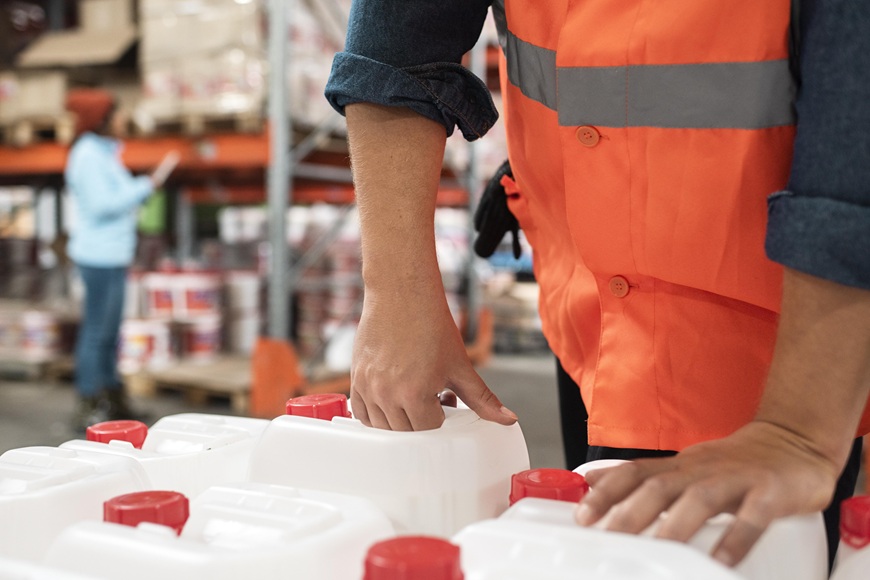
For chemical and industrial products, packaging must withstand mechanical stress, pressure, transport conditions and potential chemical reactivity. The priority is not only preserving product integrity, but also ensuring safe handling for operators and protection of the surrounding environment.
From our experience, challenges often arise when packaging is selected based on cost alone without considering long-term exposure to aggressive substances or distribution/transport conditions.
Depending on the application:
- Fluorinated plastics are used in certain applications to improve resistance to permeation and chemical attack from aggressive substances.
- Heavy-duty HDPE is widely used for its durability and chemical resistance while remaining lightweight for handling.
- Steel containers provide structural strength for bulk storage and transport of industrial chemicals.
The Medtrapak Approach: Practical, Experience-Led Solutions
At Medtrapak, our role goes beyond supplying packaging. We work alongside businesses to identify solutions that perform reliably in real-world environments.
Because we support clients across food production, pharmaceutical and healthcare, and industrial sectors, we understand that packaging decisions involve balancing safety, compliance, logistics, and brand/product requirements at the same time. Our focus is on delivering materials that meet those demands consistently, whether through our current offerings or customized sourcing.
Making the Right Decision
Choosing packaging based on price and aesthetics alone can lead to product loss, quality issues, compliance risks, or costly recalls. A better approach is to evaluate how your product interacts with its environment, from filling and storage to transport and final use.
If your product involves heat, oils, sensitive formulations, or regulatory oversight, it is worth speaking to a packaging partner before finalizing your material choice. Connect with our team to find the most suitable solution for your application.
